Cursive D — Uppercase & Lowercase, Stroke Order
Cursive D is the letter D in joined handwriting: a capital D made of a slanted stem and a round belly, and a lowercase d that starts with a round bowl and a tall stem on the right. This page has the stroke order, a printable practice sheet and the joins.
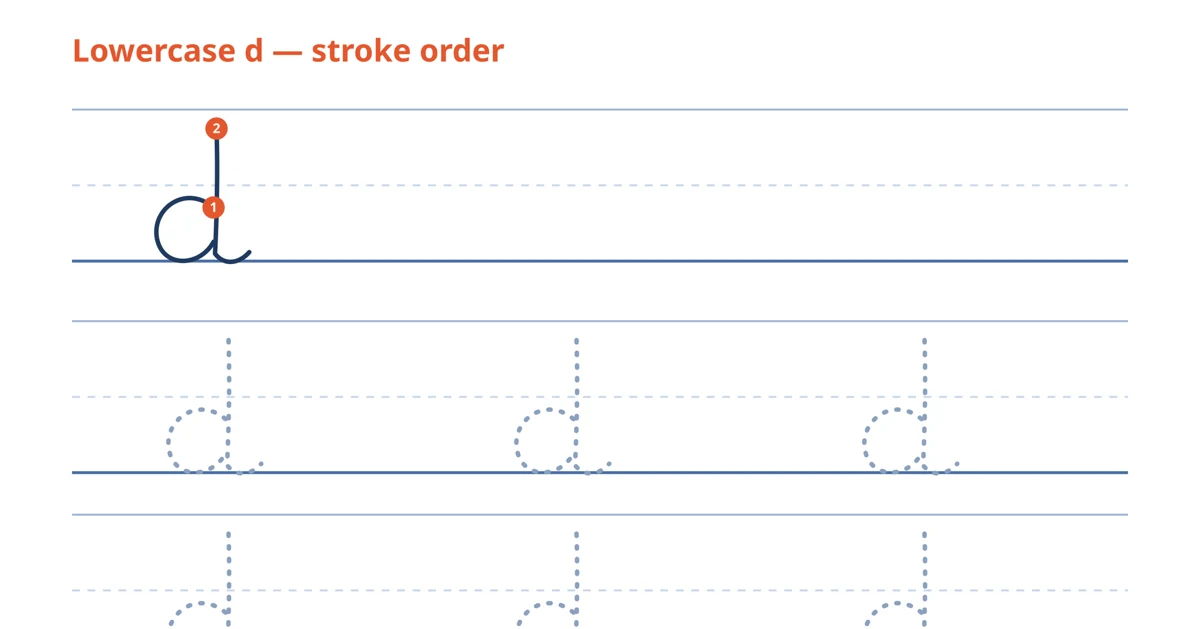
Download the A4 practice sheet (PDF) or the US Letter practice sheet (PDF). Both have the stroke order on top and dotted letters to trace.
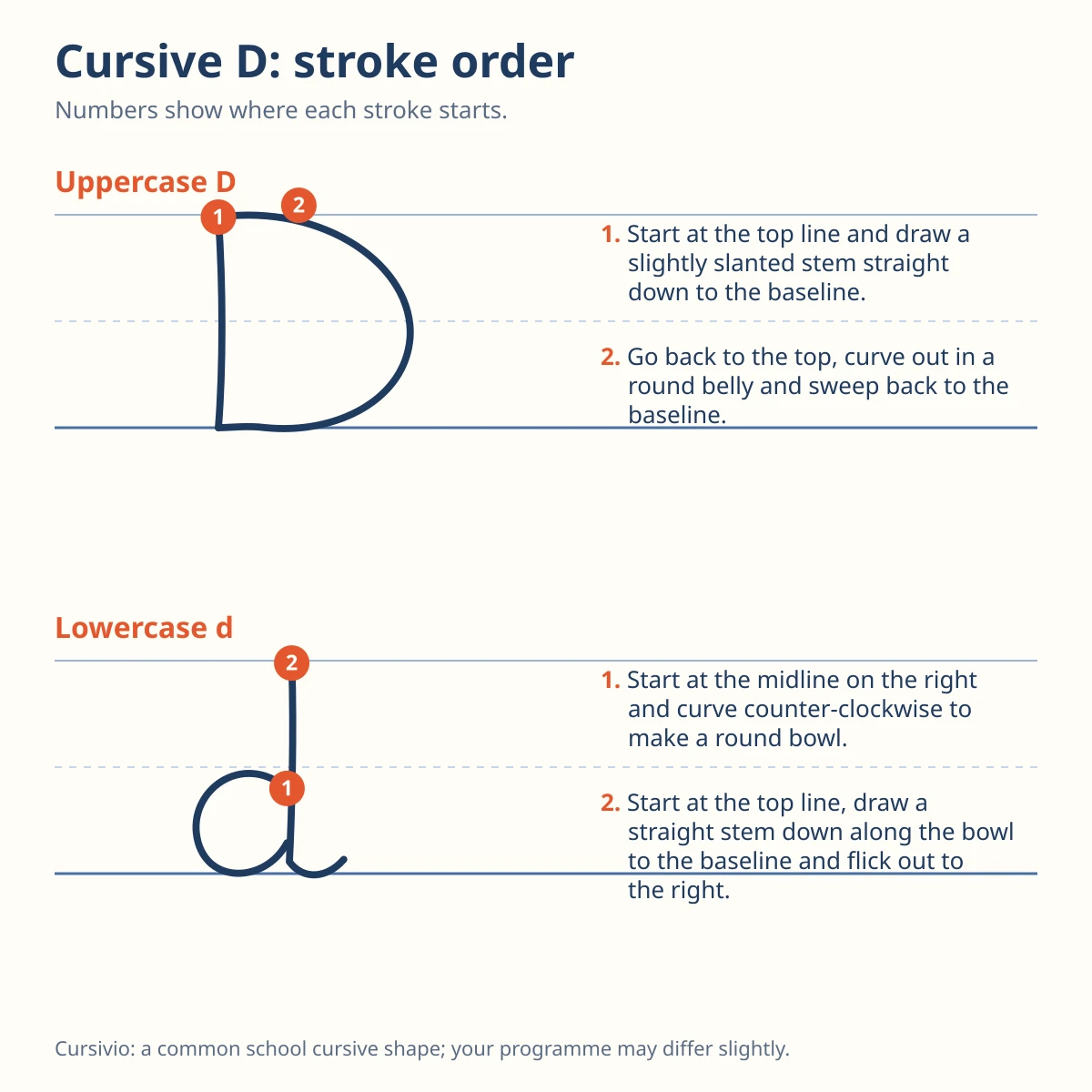
Cursive D stroke order
The chart shows each letter on three guide lines: the solid top line, the dashed midline and the heavy baseline. An orange number marks where each stroke begins. The shapes follow a common school cursive model; handwriting programmes differ a little, so your child’s school may teach a slightly different capital D.
Uppercase D
- Start at the top line and draw a slightly slanted stem straight down to the baseline.
- Go back to the top, curve out in a round belly and sweep back to the baseline.
Lowercase d
- Start at the midline on the right and curve counter-clockwise to make a round bowl.
- Start at the top line, draw a straight stem down along the bowl to the baseline and flick out to the right.
How d connects to the next letter
Lowercase d ends with a small flick at the baseline, so the join to the next letter usually runs along the bottom. The examples below show da, de and di, then do, dy and du in a script font.
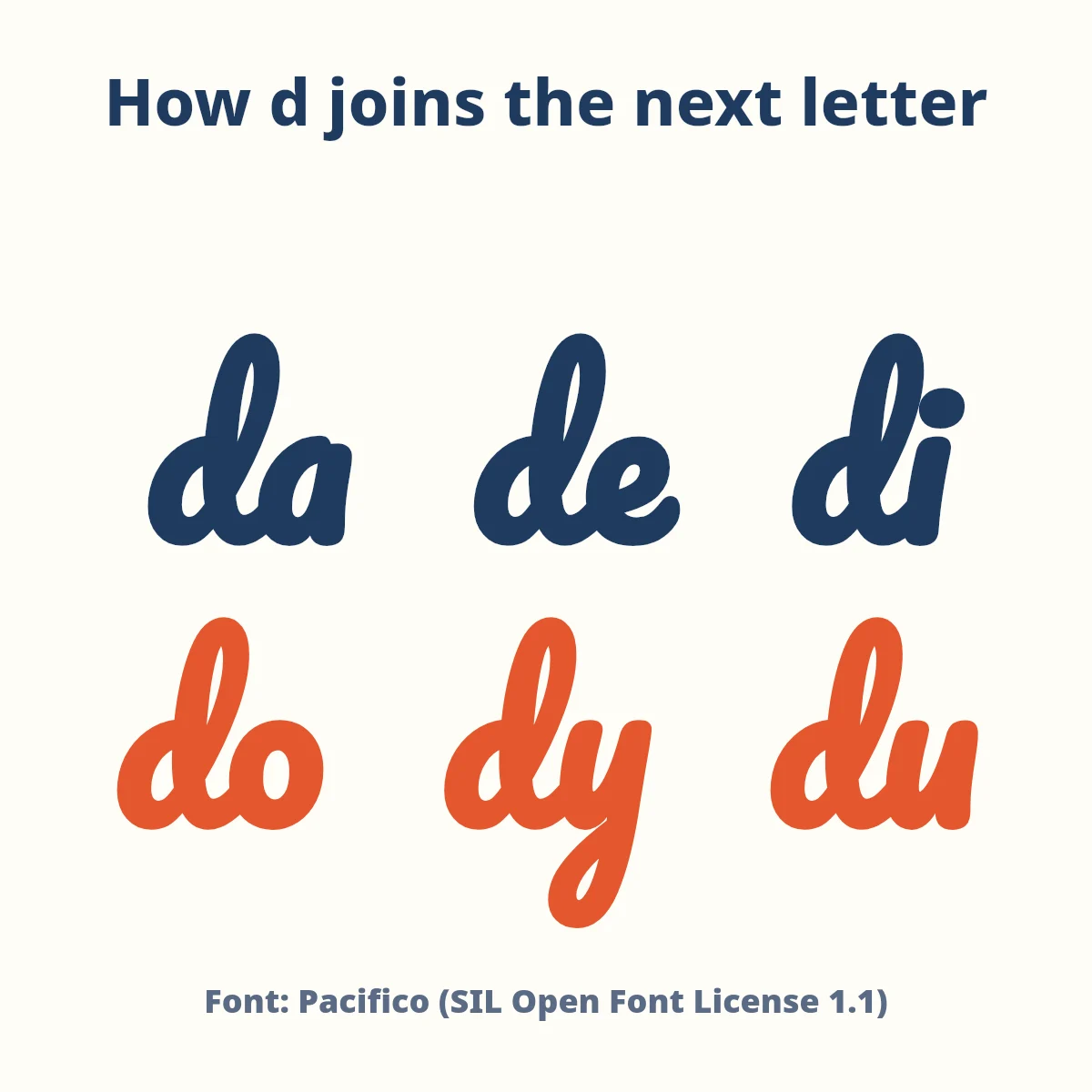
Font used for the examples: Pacifico, licensed under the SIL Open Font License 1.1. It is a display script and not a school handwriting model, so use it to see the joins, not to copy letter shapes. More about fonts is on the font licenses page.
Common mistakes with cursive D
- A bowl that does not close. The bowl of d should meet the stem; if it stays open it reads as a c next to an l.
- A short stem. The stem of lowercase d reaches the top line, about twice the height of the bowl.
- A capital D with a flat belly. Let the curve swing out and come back to the baseline in one smooth motion instead of drawing a straight side.
Practice line
Trace the dotted letters first, then write three of your own on each line. A short line to copy afterwards: daring dogs dig deep.
Questions about cursive D
How do you write a lowercase cursive d?
Start at the midline on the right, curve counter-clockwise to make a round bowl, then draw a straight stem from the top line down to the baseline and flick out to the right.
How is the capital cursive D different from the lowercase d?
The capital D is full height and made of a slanted stem and a round belly. The lowercase d has a bowl half as tall and a stem that rises to the top line.
Why does d end with a flick at the baseline?
The flick sets up the join to the next letter, so the pen can travel along the baseline without lifting.
Is this the official way to write cursive D?
No. It follows a common school cursive model, not an official curriculum. Check your school’s handwriting guide for its preferred capital D.
Looking for the rest of the letters? Go back to the Cursive alphabet chart and generator at Cursivio. Cursivio is run by the Cursivio editorial team; this page was last updated October 20, 2026.